Email Marketing for Small Businesses: Getting Started the Right Way
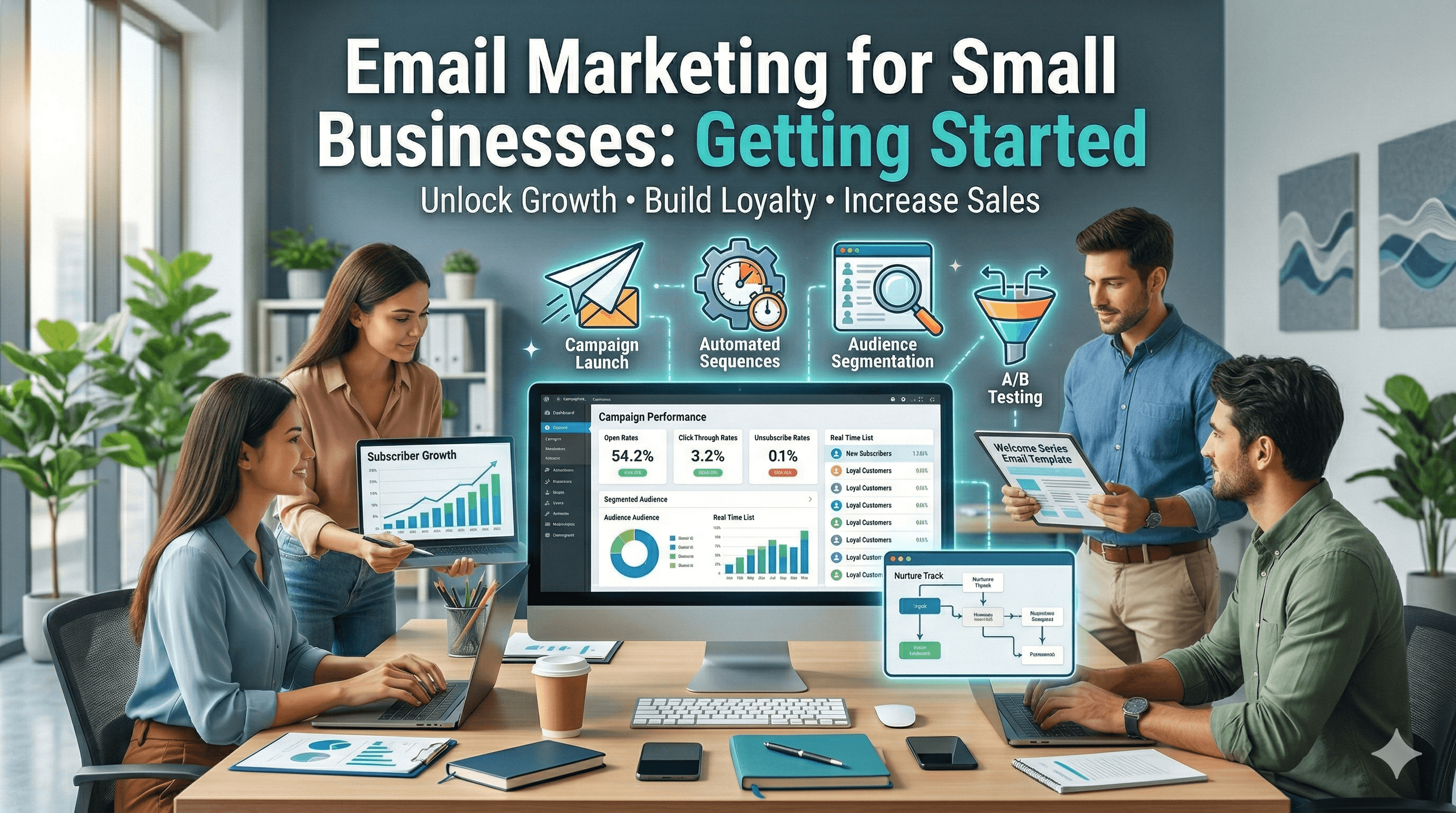
If you are a small business owner trying to decide where to invest your marketing time and budget, email should be at the top of your list. It consistently delivers the highest return on investment of any digital marketing channel. Studies show that for every dollar spent on email marketing, businesses earn an average of $36 to $42 back. No other channel comes close.
Yet many small businesses either ignore email marketing entirely or do it so poorly that they never see results. This guide will walk you through everything you need to know to get started the right way, from choosing a platform to writing emails that actually get opened and drive sales.
Why Email Outperforms Social Media for Small Businesses
Social media gets a lot of attention, but the numbers tell a different story when it comes to actual business results for small companies.
You own your email list. When you build a following on Instagram or Facebook, you are building on rented land. The platform controls the algorithm, and they can (and do) change it whenever they want. Organic reach on Facebook has dropped below 5% for most business pages. That means if you have 1,000 followers, fewer than 50 of them see your posts. With email, you control the delivery. When you send an email, it goes directly to your subscriber's inbox.
Email drives more conversions. The average email click-through rate is around 2.5% to 3%, which may sound low until you compare it to social media engagement rates that hover around 0.5% to 1% on most platforms. More importantly, people who click through from emails are further along in the buying process. They have already opted in to hear from you, which means they are warmer leads than someone casually scrolling through a social feed.
Email reaches people where they already are. Almost everyone checks their email daily. According to recent data, 99% of email users check their inbox at least once per day, and many check it several times per hour. Your email lands in a space your audience is already actively monitoring.
Email works at every stage of the customer journey. From welcoming new subscribers to nurturing leads, promoting sales, requesting reviews, and re-engaging past customers, email is flexible enough to support every stage of your relationship with a customer.
Choosing an Email Marketing Platform
You do not need an expensive or complicated platform to get started. Here is a practical comparison of three popular options for small businesses.
Mailchimp is the most well-known option and offers a free plan for up to 500 contacts. It has a drag-and-drop email builder, basic automation, and integrates with nearly every tool you might already use. The free plan is limited in features, and pricing scales up quickly as your list grows. Best for businesses that want a familiar, widely supported platform.
ConvertKit (now Kit) is built specifically for creators and small businesses that rely on content marketing. It excels at automation and tagging, making it easy to send the right message to the right person at the right time. It offers a free plan for up to 10,000 subscribers (with limited features). The email editor is simpler than Mailchimp's, which can be a pro or a con depending on your needs. Best for businesses focused on content-driven lead generation.
Brevo (formerly Sendinblue) stands out because its pricing is based on the number of emails you send, not the number of contacts on your list. This makes it an excellent choice for businesses with larger lists but lower sending frequency. It also includes SMS marketing, chat, and CRM features in its platform. Best for businesses that want an all-in-one marketing tool at a reasonable price.
Any of these three platforms will serve a small business well. The best choice is the one you will actually use consistently. For a more detailed comparison, see our review of the best email marketing tools for small businesses. If you are wondering what to budget for email marketing overall, our guide on how much email marketing costs for a small business covers platform fees, list size tiers, and agency pricing.
Building Your Email List from Scratch
Starting from zero subscribers can feel discouraging, but every successful email list started with a single signup. Here is how to build yours strategically.
Create a compelling lead magnet. A lead magnet is something valuable you give away for free in exchange for an email address. Effective lead magnets for small businesses include checklists, templates, short guides, discount codes, free consultations, or access to exclusive content. The key is that your lead magnet should solve a specific problem your target audience has. A generic "subscribe to our newsletter" offer converts at a fraction of the rate of a specific, valuable lead magnet.
Place signup forms strategically on your website. A well-designed contact form on your website can double as a lead capture tool. Do not hide your signup form on a contact page nobody visits. Place it in high-visibility locations: your homepage, the top or bottom of blog posts, your sidebar (if you have one), and as an exit-intent popup. Each placement should clearly communicate what the subscriber will get and why it is worth their email address.
Create a dedicated landing page for your lead magnet. A landing page focused entirely on your lead magnet will convert significantly better than a form buried in your website's sidebar. The page should have a clear headline, a brief description of what the subscriber will receive, an image or preview of the lead magnet, and a simple signup form. Remove navigation menus and other distractions so the only action a visitor can take is subscribing or leaving.
Promote your lead magnet everywhere. Add a link to your email signature. Mention it in social media posts. Include a call-to-action in your blog posts. If you do any public speaking, workshops, or networking events, mention your free resource and how to get it. Every touchpoint with a potential customer is an opportunity to grow your list. Once you have subscribers coming in, the next step is connecting your website to your email marketing platform so signups flow seamlessly into your campaigns.
Never buy an email list. This is worth stating explicitly. Purchased email lists are full of people who did not ask to hear from you. Emailing them will damage your sender reputation, land you in spam folders, and potentially violate laws like GDPR and CAN-SPAM. Build your list organically with people who genuinely want to hear from your business.
Writing Subject Lines That Get Opened
Your subject line is the single most important element of any email you send. If people do not open the email, nothing else matters. Here are principles that consistently produce higher open rates.
Keep it short. Subject lines with 6 to 10 words tend to have the highest open rates. Many of your subscribers will read your subject line on a mobile device, where long subject lines get cut off. Get to the point quickly.
Create curiosity or urgency (without being manipulative). Subject lines that hint at valuable information without revealing everything tend to outperform straightforward descriptions. "The mistake most small businesses make with their homepage" is more compelling than "Website homepage tips." However, always deliver on the promise of your subject line. Clickbait destroys trust.
Use numbers and specifics. "5 ways to reduce your website bounce rate" is more compelling than "How to reduce your bounce rate." Numbers stand out in a crowded inbox and set clear expectations for what the email contains.
Personalize when appropriate. Including the subscriber's first name in the subject line can increase open rates by 10% to 20%. Most email platforms make this easy with merge tags. Just do not overuse it, as subscribers will catch on if every subject line starts with their name.
Test and learn. Most email platforms offer A/B testing for subject lines. Use it. Send two different subject lines to a small portion of your list, see which performs better, and send the winner to the rest. Over time, you will develop an intuition for what resonates with your specific audience.
Writing Email Body Copy That Drives Action
Getting someone to open your email is only half the battle. The content inside needs to engage them and move them toward an action.
Write like you are talking to one person. Use "you" and "your" liberally. Avoid corporate language and jargon. Imagine you are writing to a specific customer sitting across from you at a coffee shop. That conversational tone builds connection and keeps people reading. The same principles that apply to writing website copy that converts work just as well in email.
Lead with value, not a sales pitch. The fastest way to get people to unsubscribe is to send nothing but promotional emails. Follow the 80/20 rule: 80% of your emails should provide genuine value (tips, insights, resources, stories), and 20% can be directly promotional. When you do promote something, the trust you have built makes those promotions far more effective.
Keep it scannable. Most people do not read emails word for word. They scan. Use short paragraphs (two to three sentences maximum), bullet points, bold text for key points, and clear subheadings. Make it easy for a busy person to get the gist of your email in 10 seconds and then decide to read the details.
Include one clear call to action. Every email should have one primary thing you want the reader to do: visit a blog post, check out a product, reply to a question, register for an event. Do not give them five different things to click on. One focused call to action will always outperform a scattershot approach.
End with a reason to stay subscribed. A brief teaser of what is coming next or a reminder of the value you provide gives people a reason to look forward to your next email rather than hitting unsubscribe.
How Often Should You Send Emails?
This is one of the most common questions small business owners ask, and the honest answer is that it depends on your audience and your capacity. Here are some general guidelines.
Once per week is the sweet spot for most small businesses. It is frequent enough to stay top-of-mind but not so frequent that you overwhelm your subscribers or burn out trying to create content. If weekly feels like too much at first, start with twice per month and increase when you are comfortable.
Consistency matters more than frequency. Sending one email every Tuesday is better than sending five emails one week and then going silent for a month. Your subscribers will develop expectations based on your pattern, and meeting those expectations builds trust.
Watch your metrics. If your unsubscribe rate spikes after increasing frequency, that is a clear signal you are sending too often. If your open rates stay steady or improve with more frequent sends, your audience wants to hear from you more. Let the data guide your decisions.
Avoiding the Spam Folder
Nothing kills an email marketing program faster than landing in the spam folder. Here is how to stay out of it.
Use a reputable email marketing platform. Mailchimp, ConvertKit, Brevo, and other established platforms maintain relationships with email providers and work to keep their sending infrastructure clean. Sending marketing emails from your personal Gmail or Outlook account is a fast path to the spam folder.
Authenticate your domain. Set up SPF, DKIM, and DMARC records for your sending domain. This tells email providers that your emails are legitimately coming from your business. Your email platform will provide instructions for setting these up.
Never use misleading subject lines. Email providers track engagement, and misleading subject lines lead to high unsubscribe rates and spam complaints, both of which damage your sender reputation.
Make it easy to unsubscribe. This sounds counterintuitive, but a clear, working unsubscribe link in every email is both a legal requirement and good practice. Someone who cannot find the unsubscribe button will mark your email as spam instead, which is far worse for your deliverability.
Clean your list regularly. Remove subscribers who have not opened an email in six months. A smaller, engaged list will always outperform a large, unengaged one. Most platforms offer tools to identify and remove inactive subscribers.
Measuring Success: The Metrics That Matter
You do not need to track dozens of metrics. Focus on these four and you will have a clear picture of how your email marketing is performing.
Open rate tells you how many people are opening your emails. A healthy open rate for small businesses is typically between 20% and 30%. If yours is below 15%, your subject lines need work or your list contains too many disengaged subscribers.
Click-through rate (CTR) measures how many people click a link in your email. Average CTRs range from 2% to 5%. If people are opening but not clicking, your email content or calls to action need improvement.
Unsubscribe rate should stay below 0.5% per email. An occasional unsubscribe is normal and healthy (better to lose someone who is not interested than to keep sending to someone who will never buy). A sudden spike in unsubscribes signals a problem with your content or frequency.
Conversion rate is the ultimate metric. How many email recipients are taking the action you want them to take, whether that is making a purchase, booking a call, or filling out a form? Track this by using UTM parameters on your email links and monitoring them in Google Analytics.
Getting Started Today
Email marketing does not have to be complicated, and you do not need a perfect strategy before you begin. It works best as part of a broader content marketing plan. Choose a platform, create a simple lead magnet, add a signup form to your website, and send your first email. You will learn more from sending 10 imperfect emails than from spending months planning the perfect campaign you never launch.
The businesses that succeed with email marketing are not the ones with the fanciest templates or the cleverest subject lines. They are the ones that show up consistently, provide genuine value, and treat their subscribers like real people instead of data points in a spreadsheet.
Start small, stay consistent, and let your email list become one of your most valuable business assets.