How to Get More Leads From Your Small Business Website
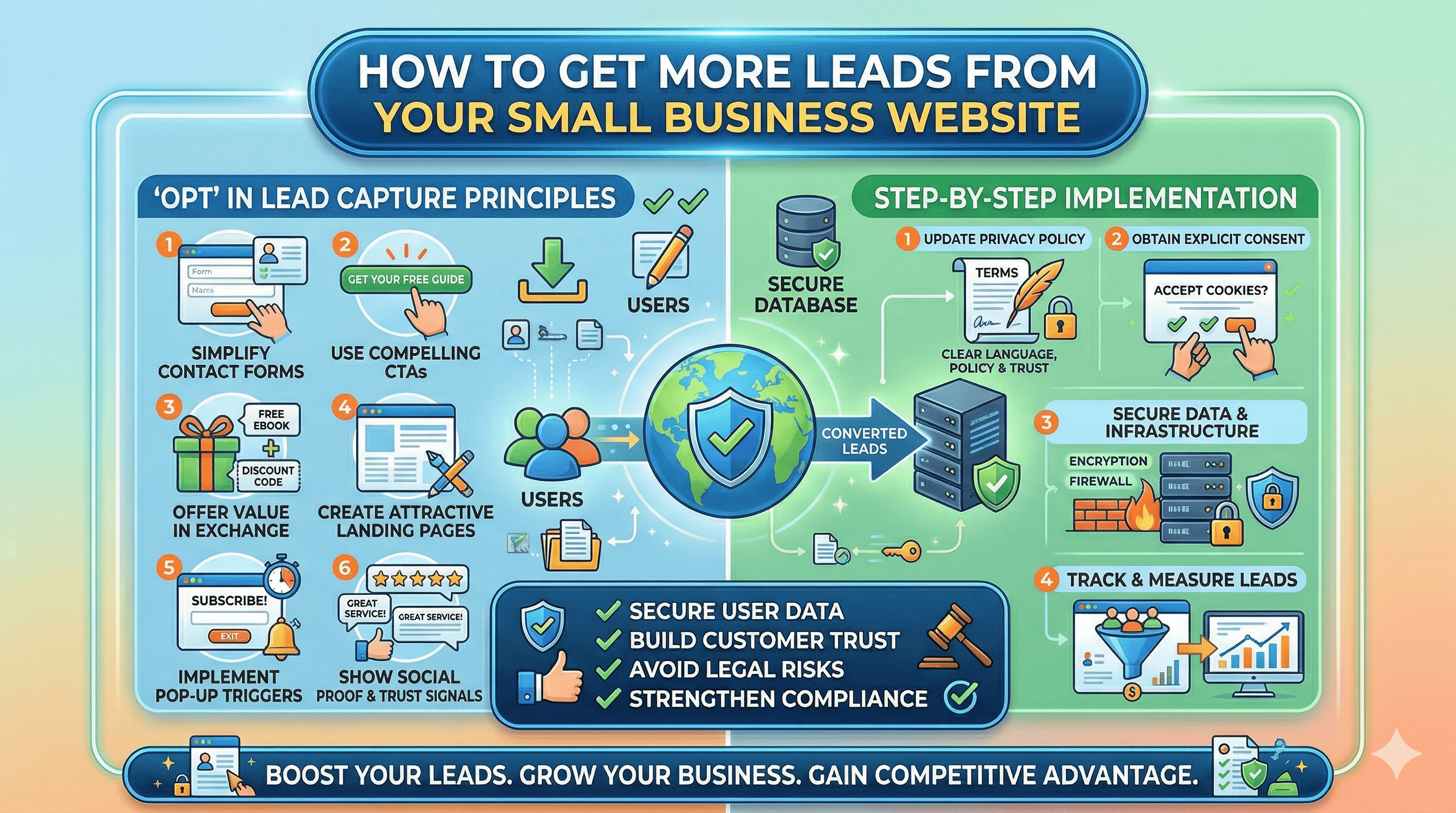
Most small business websites are digital brochures. They look nice, they describe what the business does, and they include a phone number and address. But they do not actively generate leads. Visitors arrive, browse for a minute or two, and leave without taking any action. The business never knows they were there. If this sounds like your website, you are not alone. The average website conversion rate across industries is only 2 to 3%, which means 97 out of every 100 visitors leave without making contact. This guide shows you how to turn your website from a passive brochure into an active lead generation system that captures visitor information and converts browsers into prospects.
Why Most Websites Fail at Lead Generation
Before fixing the problem, you need to understand why it exists. Most small business websites fail at lead generation for a few common reasons.
No Clear Value Exchange
Visitors will not give you their contact information just because you ask for it. They need a reason. "Sign up for our newsletter" is not compelling because nobody wants more email. Visitors need something specific and valuable in exchange for their information: a solution to a problem, a tool that saves them time, or information that helps them make a better decision.
Unclear Next Steps
Many websites describe their services thoroughly but never tell the visitor what to do next. There is no prominent button, no compelling offer, no clear path from "I am interested" to "Let me take action." If you make visitors work to figure out how to contact you or what step to take, most of them will not bother.
One-Size-Fits-All Approach
Different visitors are at different stages of the buying process. A first-time visitor who found you through a blog post is not ready for the same call to action as someone who has visited your pricing page three times. Yet most websites offer the same "Contact Us" form to everyone, regardless of where they are in their journey.
No Follow-Up System
Even when a website does capture a lead, many small businesses fail to follow up promptly or systematically. A lead that is contacted within five minutes is 21 times more likely to convert than one contacted after 30 minutes. Without a follow-up system, leads go cold and the initial capture effort is wasted.
Lead Capture Fundamentals
Effective lead capture is built on a simple formula: the right offer, presented to the right audience, at the right time, with the right follow-up. Let us break down each component.
The Right Offer
Your lead capture offer must be valuable enough that visitors willingly exchange their contact information for it. The best offers solve a specific problem your target customer has or help them make a decision they are currently facing.
Lead magnets are free resources offered in exchange for an email address. Effective lead magnets include checklists (a "10-Point Website Security Checklist"), guides ("The Complete Guide to Hiring a Contractor"), templates ("Free Social Media Content Calendar Template"), calculators ("Renovation Cost Estimator"), quizzes ("What Type of Insurance Do You Actually Need?"), and video trainings ("5-Minute Setup Guide for Your First Ad Campaign").
The best lead magnets are specific (they address a narrow topic), actionable (the visitor can use them immediately), and quick to consume (a 2-page checklist converts better than a 50-page ebook because the perceived effort is lower).
Service-based offers work well for businesses that sell services directly. Free consultations, free audits, free estimates, and free assessments all give the visitor something of tangible value while giving you the opportunity to start a conversation. "Get Your Free 15-Minute Website Audit" is more compelling than "Contact Us" because the visitor knows exactly what they will receive.
The Right Audience
Not all website traffic is equal. A visitor who found your blog post through a Google search for "how to fix a leaky faucet" has different intent than someone who searched for "plumber near me open now." Your lead capture strategies should match the visitor's intent and stage.
Informational visitors are researching a topic. They are not ready to buy but may be ready to download a helpful resource. Offer educational lead magnets that relate to the content they are reading.
Consideration visitors are comparing options and evaluating solutions. They may be ready for a more direct offer like a free consultation, a product demo, or a comparison guide.
Decision visitors are ready to take action. They are looking at your pricing page, your contact page, or your product pages. Make it as easy as possible for them to convert with prominent CTAs, click-to-call buttons, and simple forms. Our guide on creating effective calls to action covers the specifics of writing and designing CTAs that drive conversions.
The Right Time
Timing your offers correctly increases conversion rates dramatically. Display lead magnets after the visitor has demonstrated engagement (scrolled 50% down a page, spent 30 seconds on the site, or visited multiple pages). Show exit-intent popups when the visitor moves their cursor toward the browser's close button. Present service offers on high-intent pages (pricing, services, case studies).
Avoid interrupting visitors immediately. A popup that appears before someone has read a single sentence is annoying and counterproductive. Give visitors time to engage with your content before presenting an offer.
Lead Magnets That Work
Not all lead magnets are created equal. The best ones share a few characteristics.
Solve One Specific Problem
A lead magnet titled "Everything You Need to Know About Marketing" is too broad to be compelling. "The 5-Step Facebook Ad Template for Local Restaurants" is specific enough that the right audience cannot resist downloading it. Narrow your lead magnet's focus to a single, specific problem your target customer faces.
Deliver Quick Wins
The best lead magnets provide immediate value. A checklist the visitor can use today is more effective than a comprehensive guide they will "get to eventually." The faster someone experiences value from your lead magnet, the more they trust you and the more likely they are to become a customer.
Demonstrate Your Expertise
Your lead magnet should showcase your knowledge in a way that makes the visitor think, "If their free stuff is this good, their paid services must be excellent." It is a sample of your expertise that builds confidence in your ability to deliver results.
Match Your Services
Your lead magnet should naturally lead toward your paid offering. A financial advisor offering a "Retirement Readiness Scorecard" captures leads who are thinking about retirement planning, which is exactly the service they sell. The lead magnet qualifies the lead while providing value.
Optimizing Your Pages for Lead Capture
Your website's pages need to be structured to guide visitors toward your lead capture points.
Homepage
Your homepage should immediately communicate what you do, who you serve, and what action the visitor should take. Include a primary CTA above the fold (the area visible without scrolling). Feature your strongest lead magnet or service offer prominently. Include social proof (testimonials, client logos, review counts) to build trust quickly.
Service and Product Pages
These pages attract high-intent visitors. Include prominent CTAs for direct conversion actions (request a quote, schedule a consultation, buy now). Add a secondary CTA for visitors who are not yet ready (download a relevant guide, sign up for a free trial). Use persuasive copy that addresses objections and reinforces value.
Blog Posts and Content Pages
Content pages attract informational visitors who may not be ready to buy. Embed relevant lead magnets within the content (inline CTAs after key sections). Place a content upgrade (a lead magnet specifically related to the blog post's topic) at the end of each post. Use sidebar or sticky CTAs for newsletter sign-ups or general lead magnets.
Landing Pages
Dedicated landing pages are purpose-built for lead capture. Unlike regular website pages, landing pages remove navigation menus, sidebars, and other distractions. They focus the visitor's attention entirely on one offer and one action.
An effective landing page includes a clear, benefit-focused headline. A brief description of what the visitor will receive. Three to five bullet points highlighting the value. Social proof (testimonials, download counts, logos). A simple form (name and email for lead magnets, slightly more fields for service inquiries). A prominent CTA button with action-oriented text.
Contact and Form Pages
Your contact page should make it effortless to reach you. Include multiple contact methods (form, phone, email, chat if available). Keep your contact form short. For initial inquiries, name, email, and a message field are usually sufficient. Every additional field reduces form completions. Display your response time ("We respond within 2 hours during business hours") to set expectations and motivate submissions.
The Follow-Up System
Capturing a lead is only the beginning. Your follow-up system determines whether that lead becomes a customer.
Speed of Response
Respond to new leads as fast as possible. Studies show that responding within five minutes dramatically increases conversion rates compared to even a 30-minute delay. Set up email or SMS notifications so you know immediately when a new lead comes in. If you cannot respond personally within minutes, set up an automated acknowledgment email that confirms receipt and sets expectations for when you will follow up.
Email Nurture Sequences
Not every lead is ready to buy immediately. An email nurture sequence keeps your business top of mind while building trust over time. For leads who downloaded a lead magnet, send a follow-up sequence that delivers additional value, shares relevant case studies, addresses common objections, and eventually presents a direct offer. For a deeper dive into email strategy, read our guide on email marketing for small businesses.
A basic nurture sequence might look like this. Day 0: Deliver the lead magnet and welcome the new subscriber. Day 2: Share a related blog post or additional tip. Day 5: Tell a customer success story relevant to the lead's interest. Day 8: Address a common objection or FAQ. Day 12: Present your offer with a clear CTA.
Lead Scoring
If you generate a high volume of leads, not all of them deserve the same level of attention. Lead scoring assigns points based on actions (visiting the pricing page is worth more points than reading a blog post) and demographics (a lead matching your ideal customer profile scores higher). This helps you prioritize follow-up time on the leads most likely to convert.
Most CRM tools and marketing automation platforms include lead scoring features. Even a simple manual system (rating leads as hot, warm, or cold based on their actions) is better than treating every lead the same.
CRM and Tracking
Use a CRM (Customer Relationship Management) tool to track every lead from initial capture through conversion. Even a simple free CRM like HubSpot CRM or the free tier of Zoho CRM is far better than tracking leads in a spreadsheet or, worse, in your memory. Record every interaction: when they submitted the form, what they downloaded, when you followed up, what they said, and what the next step is.
Measuring and Improving Lead Generation
You cannot improve what you do not measure. Track these metrics to understand and optimize your lead generation performance.
Key Metrics
Conversion rate by page. Which pages generate the most leads relative to their traffic? Your pricing page might convert at 8% while your blog converts at 1%. Both are important, but understanding the difference helps you allocate optimization effort.
Cost per lead. If you are driving traffic through paid advertising, calculate how much each lead costs. Divide your total advertising spend by the number of leads generated.
Lead-to-customer rate. What percentage of leads eventually become paying customers? If you generate 100 leads per month but only 2 become customers, either your lead quality is low or your follow-up process needs improvement.
Time to conversion. How long does it take from initial lead capture to closed sale? Understanding this timeline helps you set realistic expectations and design appropriate nurture sequences.
Connecting these metrics to your broader website performance measurement gives you a complete picture of how your online presence drives business results.
Continuous Improvement
Review your lead generation metrics monthly. Identify your highest-converting pages and offers, then create more content and offers similar to what works. Test different lead magnets, form designs, CTA copy, and landing page layouts. Even small improvements compound over time: improving your conversion rate from 2% to 3% is a 50% increase in leads from the same traffic.
Getting Started This Week
You do not need to implement everything in this guide at once. Here is a practical sequence for getting started.
This week: Audit your website. Visit every key page and ask: Is there a clear call to action? Is there a reason for a visitor to leave their contact information? Fix any pages that have no CTA at all.
Next week: Create one lead magnet relevant to your most popular content or service. Set up a simple landing page to promote it.
Week three: Set up an email nurture sequence of three to five emails for new leads. Configure notifications so you are alerted immediately when a new lead comes in.
Week four: Review your results. How many leads did you capture? What is your conversion rate? Where are the biggest opportunities for improvement?
From there, continue adding lead magnets, optimizing your pages, testing new approaches, and refining your follow-up system. Every improvement you make builds on the previous ones, and over time, your website transforms from a passive brochure into your most productive salesperson, working around the clock to fill your pipeline with qualified prospects.