Local SEO for Small Businesses: The Complete Guide
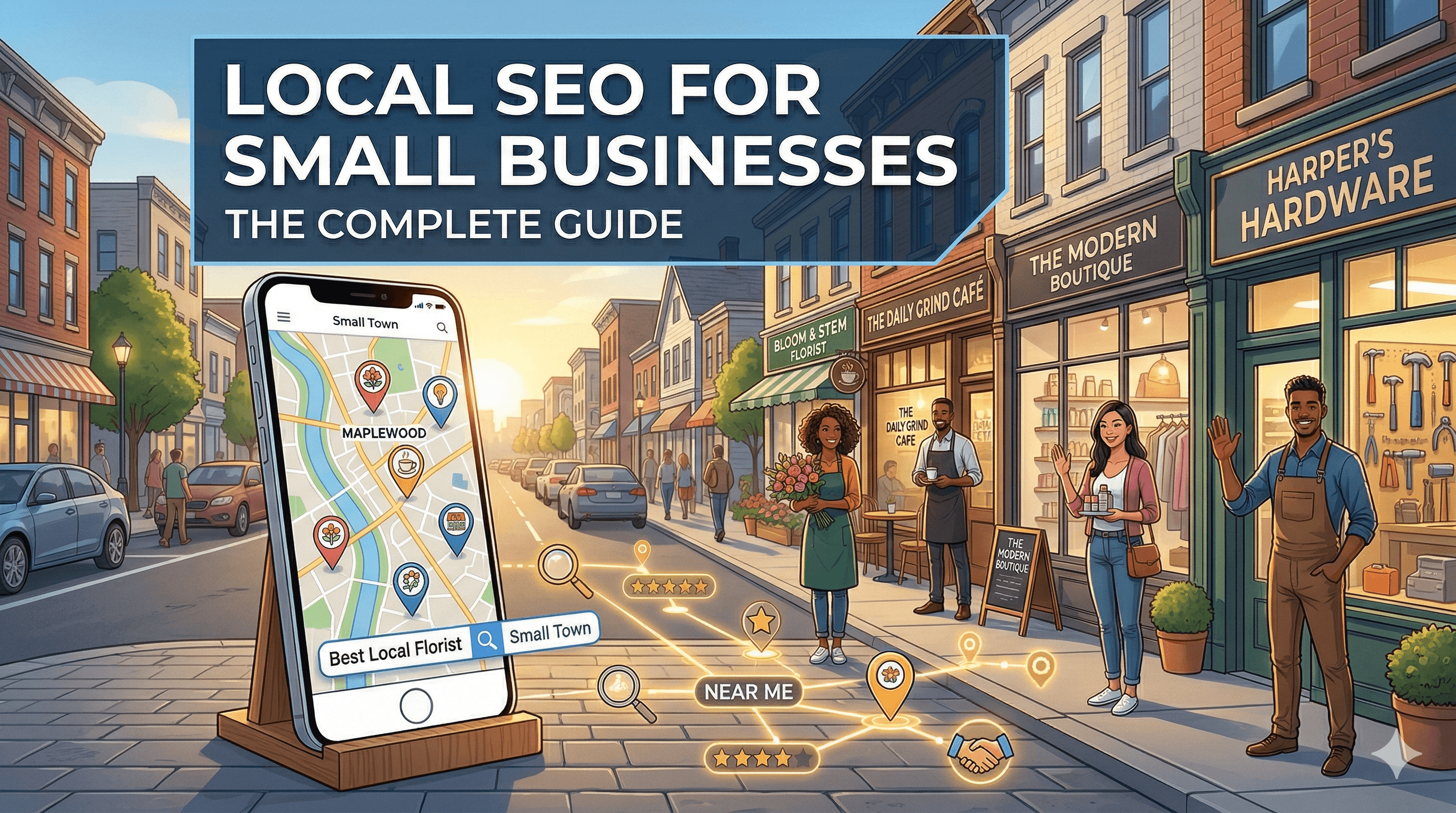
When someone in your area searches for a business like yours, local SEO determines whether they find you or your competitor. For small businesses that serve a specific geographic area, local SEO is not just one marketing channel among many. It is often the most important one. Nearly half of all Google searches have local intent, and the businesses that show up in those results capture a disproportionate share of customers. If you are new to the concept, our primer on what local SEO is and why it matters explains the fundamentals before diving into strategy.
This guide covers everything you need to know about local SEO, from optimizing your Google Business Profile to building citations and earning reviews that drive real customers to your door.
How Local Search Actually Works
When someone types "plumber near me" or "best coffee shop in downtown Austin," Google uses a different set of ranking factors than it does for general searches. Local results are influenced by three primary factors: relevance (how well your business matches the search query), distance (how close your business is to the searcher), and prominence (how well-known and trusted your business is online).
Google displays local results in two main formats. The Local Pack (also called the Map Pack) is the set of three business listings that appear at the top of search results with a map. These listings come from Google Business Profile data. Below the Local Pack, organic results show regular web pages, including local business websites.
To rank in the Local Pack, you need an optimized Google Business Profile. To rank in local organic results, you need a well-optimized website with location-relevant content. The strongest local SEO strategy targets both. For a broader overview of how SEO works for small businesses, including local and non-local strategies, read our comprehensive SEO guide.
Optimizing Your Google Business Profile
Your Google Business Profile (GBP) is the single most important asset for local SEO. It is free, and optimizing it can put your business in front of hundreds or thousands of local searchers every month.
If you have not claimed your profile yet, our article on why small businesses need Google Business Profile explains the setup process and the specific benefits. If you already have a profile, here is how to optimize it for maximum visibility.
Start with your business information. Your business name should match your real-world name exactly. Do not stuff keywords into it (for example, "Joe's Plumbing" is correct, "Joe's Plumbing, Best Emergency Plumber in Denver" violates Google's guidelines and risks suspension). Choose your primary category carefully, as it is one of the strongest ranking factors. Pick the category that most precisely describes your core business. Then add all relevant secondary categories.
Your business description should clearly explain what you do, who you serve, and what makes you different. Use natural language and include your key services and service area without keyword stuffing. You have 750 characters, so make them count.
Add your complete and accurate business hours, including special hours for holidays. List your phone number with the local area code. Add your website URL. If you serve customers at their location (like a contractor or mobile service), set your service area instead of (or in addition to) your physical address.
Photos matter more than most business owners realize. Businesses with photos receive 42% more requests for driving directions and 35% more click-throughs to their website. Upload high-quality photos of your storefront, interior, team, and your work. Add new photos regularly. Google favors active, regularly updated profiles.
Use Google Posts to share updates, offers, events, and news directly on your profile. Posts appear in your listing and give potential customers another reason to engage with your business. Post at least once per week for the best results.
Building Local Citations and NAP Consistency
A citation is any online mention of your business name, address, and phone number (NAP). Citations appear on business directories, social media profiles, review sites, and industry-specific platforms. They are a key ranking factor for local SEO because they validate that your business is real and located where you say it is.
The most important thing about citations is consistency. Your business name, address, and phone number must be identical everywhere they appear. "123 Main Street" and "123 Main St." are different in Google's eyes. "Joe's Plumbing LLC" and "Joe's Plumbing" are different. Pick one format and use it everywhere.
Start with the core citation sources that matter most. These include Google Business Profile, Bing Places, Apple Maps, Yelp, Facebook, the Better Business Bureau, and your industry-specific directories. For a restaurant, that might include TripAdvisor and OpenTable. For a contractor, it might include HomeAdvisor and Angi. For a healthcare provider, it might include Healthgrades and Zocdoc.
You can build citations manually (creating an account and filling out your profile on each site) or use a citation management service like BrightLocal, Moz Local, or Yext to distribute your information to dozens of directories at once. Manual is cheaper but time-consuming. Automated services cost $5 to $50 per month but save significant time.
Audit your existing citations at least once a year. Search for your business name and look for outdated or inconsistent listings. Old phone numbers, former addresses, and duplicate listings confuse both search engines and potential customers. Clean these up whenever you find them.
Managing and Earning Reviews
Reviews are one of the three most important local ranking factors, and they directly influence whether potential customers choose your business or a competitor's. A business with fifty positive reviews and a 4.5-star rating will almost always win over a business with three reviews, even if the three-review business has a perfect 5.0.
To earn more reviews, you need to ask. Most happy customers are willing to leave a review if you make it easy. Create a direct link to your Google review form (search "Google review link generator" for tools that create a short URL). Share this link in follow-up emails, text messages, receipts, and even on a printed card you hand to customers after completing a job.
Time your requests thoughtfully. Ask for reviews when satisfaction is highest: right after a successful project, a positive service experience, or a compliment from the customer. Do not wait days or weeks, as the enthusiasm fades and the likelihood of follow-through drops.
Respond to every review, both positive and negative. Thank positive reviewers by name and mention something specific about their experience. For negative reviews, respond professionally, acknowledge the concern, and offer to resolve the issue offline. Potential customers read your responses just as carefully as they read the reviews themselves. A thoughtful response to a negative review can actually build trust.
Never buy fake reviews, offer incentives for reviews, or use review-gating (only sending review requests to customers you think will leave positive feedback). Google actively detects and penalizes these practices, and getting caught can result in your reviews being removed or your profile being suspended.
Location-Based Content Strategy
Your website content plays a major role in local search rankings. Creating location-relevant content signals to Google that your business serves specific geographic areas and helps you rank for local search terms.
Start with your service area pages. If you serve multiple cities or neighborhoods, create a dedicated page for each one. These pages should not be thin, duplicate content with just the city name swapped in. Each page needs unique content that mentions local landmarks, neighborhoods, or specific information relevant to that area. A roofing company might discuss the specific weather challenges in each city. A real estate agent might highlight neighborhood amenities and market trends.
Your blog is another powerful tool for local content. Write about local events, community news, partnerships with other local businesses, and location-specific tips. A restaurant might publish a guide to local farmers' markets. An accountant might write about state-specific tax deadlines. This type of content attracts local search traffic and positions you as an active member of the community.
Finding the right local keywords to target is essential for this strategy. Our guide on how to do keyword research for small business walks through the process of identifying the search terms your local customers actually use.
Add location signals throughout your site. Include your full address and phone number in your footer. Embed a Google Map on your contact page. Use location-specific terms naturally in your page titles, headings, and content. Create a comprehensive contact page with directions from major landmarks or highways.
Local Link Building
Backlinks from other local websites are a strong local ranking signal. Local links are often easier to earn than general backlinks because they are based on real community relationships.
Join your local Chamber of Commerce. The membership typically includes a listing on their website with a link to yours. Sponsor local events, sports teams, or charities. These sponsorships often come with a link from the organization's website. Partner with complementary local businesses for cross-promotion and reciprocal links.
Get listed in local media. Reach out to local newspapers, blogs, and news sites when you have a newsworthy story: a grand opening, a community event, an award, or expert commentary on a local issue. Local journalists are always looking for sources, and a mention in a local news article provides both a valuable link and exposure to a local audience.
Our starter guide on local SEO for small businesses covers additional local link building tactics and quick wins you can implement this week.
Tracking Your Local SEO Performance
Measure your local SEO efforts so you know what is working and where to focus your time.
In your Google Business Profile dashboard, track the number of profile views, search queries that triggered your listing, direction requests, phone calls, and website clicks. These metrics show how visible your profile is and how often it drives action.
In Google Search Console, monitor your rankings for local keywords (terms that include your city, neighborhood, or "near me"). Track impressions and click-through rates for these terms over time.
Use a local rank tracking tool like BrightLocal, Whitespark, or SE Ranking to monitor your positions in the Local Pack for your target keywords. Local rankings vary significantly by the searcher's exact location, so these tools simulate searches from specific addresses to give you accurate data.
Monitor your review velocity (how many new reviews you receive per month), your average rating, and the sentiment of your reviews. If negative reviews spike, investigate the root cause quickly.
Applying Local SEO to Your Industry
These local SEO principles apply across every industry, but the specifics vary depending on your business type. For industry-specific local search guidance, we have detailed walkthroughs for dental practices, real estate agents, photographers, restaurants, law firms, veterinary clinics, automotive businesses, and franchise operations.
If your business has multiple locations, managing local SEO becomes more complex. Our guides on multi-location SEO for Google Maps, managing Google Business Profiles for multiple locations, NAP consistency tools, and structuring your website for multiple business locations cover the key strategies.
Your Local SEO Action Plan
Local SEO is not a one-time project. It is an ongoing practice that compounds over time. Here is your priority order for getting started.
First, claim and fully optimize your Google Business Profile. This is the highest-impact, lowest-effort step. Second, ensure your NAP is consistent across your website, GBP, and the top ten citation sources. Third, implement a systematic process for asking customers for reviews. Fourth, create location-specific content on your website, starting with your most important service area. Fifth, pursue local link building opportunities through community involvement and partnerships.
Start with these five steps, measure your results over 90 days, and adjust your strategy based on the data. Local SEO rewards consistency and patience. The businesses that show up every day, publish local content, earn reviews, and maintain their profiles are the ones that dominate local search results.